Left To Write
With Apologies to Lewis Caroll
T’was chaos in the Office Ove;
It smelled of Musk and Micky Dees.
His edict/orders print in bold;
And Sharpie-signed for all to see.
Beware the MAGA hats my son,
Their jaws that snipe and liberals bash;
Beware the Orange-haired one; and shun
His constant lies and talking trash.
He took his Sharpie in his hand;
The Constitution there he sought.
His elbows on the Resolute Desk;
He pretended to be lost in thought.
Then Elon came with eyes aflame,
And chainsaw in his heartless hands.
He stormed into the Office Ove.
To wreak destruction with his man.
And so, they did. Sliced through and through,
With saw and Sharpie. Snicker, snack;
The Constitution shredded, there,
No guarantee was left intact.
“We’ve done the deed,” they sniggered proud;
“The Constitution, we have trashed,
A beautiful day; Callooh! Callay!”
With saw and Sharpie; slashed and slashed.
T’was chaos in the Office Ove;
It smelled of Musk and Micky Dees.
His edict/orders print in bold;
And Sharpie-signed for all to see.
There we stood, alone,
just the four of us,
in a vast desert, far larger
than the Sahara.
Climbed gentle backs of
dune after dune,
wind at our backs, stumbling down
the steep lee of each.
Twenty degrees north latitude,
northwesterly wind gusts,
blinded by blowing sand,
seared by desert heat.
Down into a trough between dunes
towering hundreds of feet,
lost in an endless sea
of the brightest white.
But this desert died
millions of years ago,
existing now only
in my imagination.
I stood upon rock of the rim,
Utah’s Snow Canyon State Park,
gazed down at rocks below ––
the Jurassic Navajo Sandstone.
Petrified dunes that last saw light
one hundred seventy million years ago,
rising up over time,
eroded by wind and water.
Then, one point four million years ago,
lavas poured forth
over a plateau of this exhumed
ancient petrified desert.
Streams cut canyons into sandstone and basalt
Three hundred thousand years later,
more lava poured forth, from fissures to the north,
filling valleys with fresh lava.
On the final morning of our St George visit,
I stood upon those hardened basalts,
and gazed one last time
into the canyon below.
White cliffs of Navajo sandstone to the west,
the valley filled by a third flow,
a mere fifteen thousand years past,
enveloping ancient dunes
that once danced across a vast desert.
Took my last few photos,
down into the valley, and
up to the pass to the north,
from which the lava last flowed.
“Let me look at our refund policy. OK if I put you on a brief hold?”
“No, no. I prefer you put me on a long hold.”
“Sir?”
“Yeah, no. Put me on a hold for the ages. Put me on a hold that reflects Halley’s lazy loop through the solar system. Here’s Earth, here’s the Sun, zip past Mercury, dodge Neptune decades later then slowly, slowly, arc that U-turn and come back our way, so my grandson can see you in the night sky.
“Put me on a hold measured in millenia. Start with Cro-Magnons huddled in caves, fleeing the unstoppable glaciers grinding their way down from the north, then melt those glaciers, evolve those Cro-Magnons to Homo sapiens. And put those men in mud and wattle huts, then wooden cabins, then stone castles, then steel skyscrapers.
“I want a hold that feels the bump and grind of tectonic plates, scraping and shoving an ocean bottom, littered with seashells, until that ocean bottom becomes a mountain top – swept by icy monsoons and littered with oxygen tanks and those too foolish to turn back when their own oxygen ran out. And now the mountaineer and the seashell lie together.
“Give me a hold where the sun shines down on a tennis match, a picnic, a walk in the woods, and extends through that same sun becoming a red giant. No longer so inviting to tennis players, picnickers, or sylvan strollers.
“I want a hold that poets immortalize in Alexandrian quatrain, playwrights fill Broadway theaters with, and Tom Cruise hopes to turn into Mission Impossible: Nine.
“Let’s not make this a vanilla hold, a 50th percentile hold, a ‘meh’ hold. When people hear of this hold, I want them to gnash their teeth, to rend their garments, to keen so shrilly that windows shatter for three blocks around.
“Can you put me on that kind of hold?
“Yeah, um, we’ll just credit you the four dollar refund sir.”
“I’m happy to stay on the line for a brief survey, if you like.”
In our yard, next to the old barn, there grew a lilac bush.
Lilac tree, really. It was big enough for an 8-year-old girl to climb.
When I was sad, or my feelings were crushed,
……. or I was just mad at people,
I’d sit on the third branch up, believing no one could see me.
And then I could cry.
On a day in May, when the full tilt fragrance filled the air,
I stifled my sobs as my mother approached, scissors in hand.
It must have been a Sunday. She was humming a hymn
as she snipped an armload of lilacs for the dining room table.
If she saw me, she didn’t let on.
You might think that’s harsh or unfeeling of her, but I did not.
Some cries belong only to oneself, coming from so deep down
they are invisible to outsiders. Only the flowers and leaves
could see and hear me, and stood guard until sadness subsided
and the crying stopped.
I often came across my mother crying alone after my brother died.
Always late at night, on the couch, with just the TV for company.
I silently got my drink of water or used the bathroom
and crept back upstairs to bed, never looking her way.
Yet I felt her body heave.
My mother and I spent a lot of time screaming at each other.
Too different, or too alike? Both, I suppose. But love between us grew,
even blossomed, as we shed our petals of tears through the years.
I knew she’d died before they called me, I heard the hymn she sang.
……. I miss her.
Especially when the lilacs bloom.
This is a season of reflection,
A reckoning, if you will.
Is life’s cup brimming over,
Or waiting for a fill?
As we look back across the year just passed,
Loss filled many hours and days.
Loss of a loved one, a lost ideal,
A loss of dreams in many ways.
This season also brings thankfulness,
As we try to balance our books.
We learn that gratitude can conquer loss.
We give hope another look.
Examine again your little cup.
Give yourself some grace.
Then turn to help someone else.
Your cup is full, grief erased.
As we sit among our company here,
Each face so warm and appealing,
I wish you laughter and good memories.
I wish you peace and healing.
One day, two men; which
do we honor for Justice,
Peace, Truth and Outlook?
A calendar day can
unite or divide people.
Choose wisely, my friend.
Cirque du l’Orange or
I Have a Dream Today?
Jan. 20 this year.
Cloudy future waits.
Will Martin or Donald define
This day they will share?
By James C. Nelson, Montana Supreme Court Justice (Ret.)
I want to offer you a different lens through which to better understand the climatological and environmental crises that we—indeed all of humanity—are facing. I would like you to view these crises through the long lens of our planet’s geologic and evolutionary history.
From the beginning of our planet’s formation, some 4.6 billion years ago, to the present there have been five major extinction events which destroyed anywhere from 70% (during the Devonian Period) to 95% (at the end of the Permian Period) of all living things on earth. These extinctions were natural events: caused by some combination of rapid and dramatic changes in climate, combined with significant changes in the composition of environments on land or in the ocean brought on by plate tectonics, volcanic activity, climate change (including the super cooling or super heating of earth), decreases in oxygen levels in the deep ocean, changes in atmospheric chemistry (acid rain), changes in oceanic chemistry and circulation, and in at least one instance, a cosmological event—the massive asteroid strike in Chicxulub, near what is now the Yucatan peninsula.
Contrary to climate change detractors, science-deniers and those who refuse to acknowledge the climatological and environmental crises facing us, any notion that these do not exist, will not come to fruition, or that humans will somehow subdue the earth is utter nonsense. Rather, it is the earth and cosmos that will, in due course, subdue all living things—as nature has already done, time and time again, for billions of preceding years.
Indeed, and to that point, our planet is presently in the midst of adverse climatological changes and a sixth major extinction event—in this instance, however, both caused by human beings.
And that brings me to the new apex predator–US.
Humans–homo—evolved from a genus of apes about 2.5 million years ago. Our species, homo sapiens, evolved from these early humans, between 300,000 and 200,000 years ago. Up until a time between 40,000 and 10,000 years ago (12,000 years ago is the date most frequently cited) humans lived in small hunting and gathering groups. It was during this time forward, that various of these hunter/gatherer groups settled in larger units—villages, towns, cities, and empires–planting and harvesting food crops, domesticating animals, and dividing labor as a more efficient way of living. Modern civilization.
If one were to view this geologic and evolutionary history through the lens of a standard 12-month calendar, life first appeared on January 1st; the dinosaurs went extinct on December 25th; humans first appeared at 11:00 pm on December 31st; and modern civilization began at two minutes before midnight on December 31st.[1]
During these two minutes homo sapiens crafted written language, digital technology, and methods to communicate information anywhere in the world in seconds. We split atoms, and harnessed their power. We sent people to the moon. Our presence in space grows more far-reaching and sophisticated each year. With our space-based telescopes, we have observed the light from a few hundred thousand years after our universe’s formation.[2] We domesticated animals, and we grew agriculture on a massive scale. We invented treatments and cures for a goodly number of ills that killed many of us less than a hundred years ago. We probed the depths of the oceans. We learned how to change the structure of DNA and genes, ours included. We developed machine intelligence that will in all likelihood, itself, become sentient in not too many years. We explored the particles and forces that comprise time, space, gravity, and the laws that created us and still enable our very existence.
All of that in those two minutes.
However, in those same two minutes we also created monotheistic religions; we wrote sacred texts; and, for good and evil, we empowered priests, pontiffs, prelates, and prophets to institutionalize our sectarian myths. We governed ourselves with warlords, kings, queens, dictators, and presidents, counting among those both the wisest and most evil and ignorant leaders. We warred against each other constantly, and killed billions of us. We explored, and we decimated indigenous populations in the process. We hold on to systemic racism, sexual and gender-based phobia, misogyny, and xenophobia. We discriminate against and punish each other for our differences. And, we have fouled our nests, our waters and our air with all manner of filth, waste, disease, pollution and, ultimately, the heat from our industries and lifestyles equivalent to 400,000 Hiroshima-sized atomic bombs detonating every day–four every second.[3] Since the start of the industrial revolution we have pumped over 2000 billion metric tons of CO2 into the atmosphere—presently, about 40 billion metric tons every year; over 5000 million metric tons by the U.S. alone.
We are the first species with the power to render our kind and most other living things extinct; and we are exercising this power to do just that. Homo sapiens has become homo extinctor (man the destroyer, the annihilator).
All in those same two minutes.
We became so smart, so fast, that we outsmarted ourselves. Modern humans have existed but for a nanosecond of geologic time. But, look at the appalling, toxic mess that we have created in our two minutes on earth.
Indeed, if we do not change course, if we do not engage our prefrontal cortex to rein-in our limbic brain, we will not be around for the next two minutes in a new January 1st. If we are to preserve the right of this and future generations to exist in a clean and healthful environment, then we must act.
And, make no mistake, we don’t have a million years to get our act together—that option is not on the table. We will not have another 40,000 years much less even 12,000 years–another two minutes– to learn to respect and nurture what our planet has given us, and to try to slow the progress of the disastrous climatologic and environmental Rubicon we are destined to cross within the next six years. As it is, it will take many thousands of years, if not more, for our planet to recoup and rebalance from the excesses and mismanagement already committed in our two minutes of stewardship.
We are at the edge of the abyss. If we don’t change, homo extinctor will have destroyed most living things, and, in the end, will have annihilated our own species.
Our two minutes on earth will be over. And, we will have squandered it.
©
[1] See, Humankind, Ruter Bregman, Little Brown and Company, 2019, at p.51.
[2] https://science.nasa.gov/mission/webb/big-bang-q-and-a/
[3] Bill McKibben, Falter, Has the Human Game Begun to Play Itself Out?, Henry Holt and Company, 2019.
at p. 22.
It was a cool evening in the fall and I was enjoying the view out of my living room window. The red maple trees in the median in front of my house and across the street were a striking bold red color this season, noticeable even in these early evening hours. When the maples turn color, they are always pretty but this year they seemed to be especially striking. Then I walked toward the back of my house and looked out at the covered patio and into my back yard. It was dusk by this time and I noticed a couple of items I had inadvertently left out when I was working in the back yard. I thought I could easily remove them without spending a lot of time outside as it got darker, so I walked out the patio door for a quick tidy-up of the back yard.
Then I heard a noise – a soft moan. I thought I was alone, outside as nighttime approached, and now I was concerned. Was someone hurt? Who was it and exactly where were they? I waited a few moments – all was quiet. I went back into the house, flipped on the patio light, picked up a flashlight, and quietly tiptoed back outside. I heard the moaning again, but I couldn’t quite tell where it was coming from. I could see the patio area and back yard, and no one was there. I have very little lighting on the side of my house, so I pointed the flashlight down the side of the house where there is a walkway to the front yard. Again I heard a soft moan but saw no one. I stopped and looked around at my yard and then peeked into my neighbor’s yard to see if either Heather or Todd were hurt or needed help. No, there was no one there. I paused to consider…think. Then I realized nobody was hurt and the moaning was not coming from my yard or my neighbor’s yard. It was October and the evening was very still and quiet. The sound of my night visitor was emanating from My Morbid Mind. I’ve never been outside at night before when they were “entertaining” people I guess, because I’ve never been aware of the sound until now. I’m typically inside my house when it begins to get dark – whatever hour that might be.
I’ll remember this occurrence for quite awhile. I’m not likely to venture outside after dark in October again. That sound can definitely be concerning, and even a bit scary (which is the goal I guess).
We were in love and decided to marry
A wedding plan we had to pursue
Finally we found the official we wanted
And were married by Judge Mary Yu
She needed to discuss it with a psychologist
Ignoring her problem would no longer work
She searched for someone she felt comfortable with
And was counseled by Dr. Tom Quirk
Ben was incarcerated again for theft
He stole from the neighborhood bank
The officer assigned to his prison cell block
Was aptly named Sgt. Robin Banks
My friend was a devoted vegetarian
Her diet consisted largely of greens
The nutritionist she hired to guide her
Was named appropriately Anita Bean
He’d had a large enough family
He searched for the area’s best doc
A vasectomy seemed the right thing to do
So it was performed by Dr. Dick Chop
NOTE:
All these are the names of real people working in the occupations mentioned.
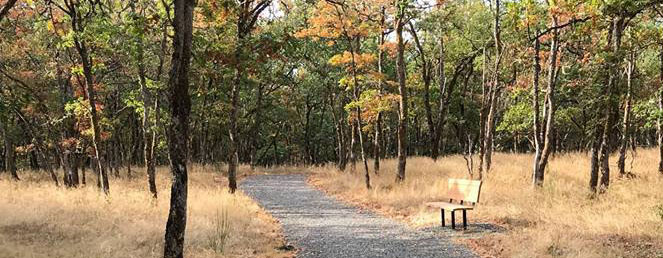
Walking through the preserve here at Ovation is so relaxing and generally quite peaceful. I can hear the small animals scurrying around sometimes, and when I walk very early in the morning, I can view the owls and other nocturnal creatures getting sleepy and bedding down. I notice the wildflowers in bloom and I look forward to seeing the yellow daffodils every spring. I often follow the trails and enjoy listening for the sounds of nature and seeing the beauty that is everywhere I look.
I walk freely anywhere in the preserve. I even end up near Marvin Road sometimes, and my mother taught me that I have to be watchful for those vehicles that travel along that road. But wherever I go, I am admired, whether I am near the road or deep in the woods. I know I am admired because people stop and stare, and I often hear the clicks of their cameras. Sometimes I pose for them, but if they get too close, I head farther down the trail and out of sight. I do remember people I’ve met before in a general way – I remember if they are on my “safe” list or if they are on my “stay away from” list.
Yes, I am aware how many admire me. And I do have many positive traits. For example, I have a gentle nature, my hearing is exceptional, I have good eyesight and superb night vision, my excellent sense of smell helps protect me, I can sprint up to 30 MPH and can leap 10 feet high or 30 feet horizontally. My favorite foods include acorns, blackberries, huckleberries, alfalfa, corn, clover, and especially apples – apples taste like candy to me. As many of you know, I sometimes eat grasses, leaves, and flowers too. My lifespan is dependent on my species and many other factors. In this state, I may live in the wild anywhere from 8 to 10 years typically.
I get along well with my admirers as long as they don’t get too close. I teach my children to always be aware of what is around them, even when they are just eating lunch or playing with each other. I have two fine looking children – a male and a female – their names are Buck and Grace. When my children were quite small, I had to walk slowly in order for them to keep up with me. They have often accompanied me when I wander the woods looking for food. Now my son is growing up so fast – his antlers are noticeable already. Grace is still fairly young, although she has lost most of the spots on her coat.
As long as my human neighbors and my family all get along, we can continue to live in harmony and share this beautiful area we all call home.
 Left To Write